

The Smart Alternative to Risky Independent Courier Contracts To Secure Your Brand
Secure guaranteed zero downtime ✓ and a dedicated, permanent delivery team ✓ at Ontime Delivery Solutions.…
This guide provides a strategic framework for Australian wholesalers and distributors to diagnose their current delivery model's hidden weaknesses and choose the right last-mile partner to drive sustainable business growth.
Are you frustrated by late deliveries and the constant firefight of managing logistics? We understand. We are Ontime Delivery Solutions, a dedicated delivery service built for businesses that need reliable, professional logistics support.
Over the past three decades, we’ve seen countless Australian businesses accept logistics headaches as just ‘the cost of doing business’. It doesn’t have to be this way.
This guide provides our exact framework for diagnosing your current delivery model and finding a final mile delivery courier solution that actively fuels your growth, not just drains your time.
To help you make this critical decision, we will walk through a clear, actionable plan for your transport needs:
Let’s turn your last mile into your strongest competitive advantage.
Why do so many businesses feel stuck with a delivery system that isn’t working? Often, it’s because they don’t have a clear way to compare their options. To solve this, let’s first define the three core models in Australia. Understanding these gives you the language and framework to see which one truly fits your business, and which one might be secretly costing you time and money on deliveries.
The reasoning here is purely transactional. This model is built for emergencies and one-off tasks, not for building a reliable, repeatable process with a consistent driver that builds your brand. It’s often used by businesses looking for a same day courier to solve a temporary problem.
For example, if you’re a law firm needing to send a single urgent document across the city immediately, this model of on-demand trucking is perfect. High-volume urban networks rely heavily on an efficient small parcel courier to hit exact delivery windows in congested metro areas. You are paying a premium for speed, so you don’t have to invest in a permanent solution for an infrequent need. Ensuring urgent goods move swiftly from the distribution hub to the consumer is perfectly managed by a general express courier.
The thought process behind running an in-house private fleet is to maintain absolute control over your brand and service quality. You hire the drivers, you own the vans, and you set the standards.
However, this means you also accept total responsibility for an entire logistics operation. For example, when your main driver calls in sick on the busiest day of the month, you are the one scrambling to find a replacement. You effectively become a part-time transport manager to guarantee your brand standards are met, but at the cost of your time and focus on core business services.
The rationale here is simple: get the control of an in-house fleet without the operational headaches through outsourcing. It’s about creating a reliable, professional delivery arm that feels like a part of your team but is managed by logistics experts. A dedicated courier service provides this exact solution.
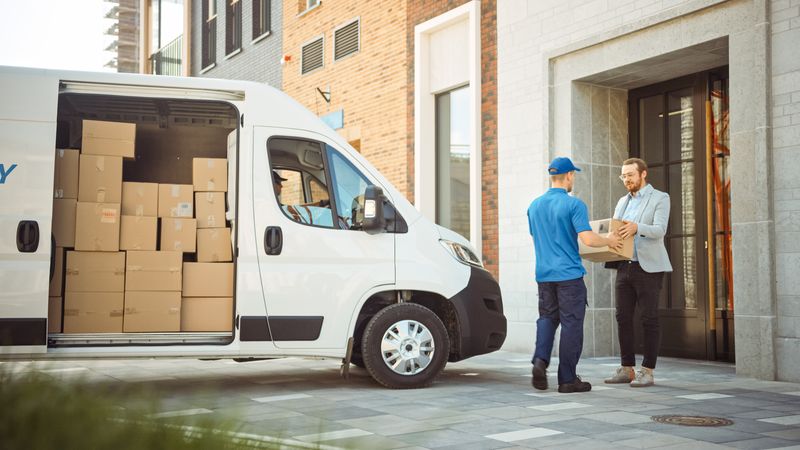
For example, instead of you owning a 4-tonne Pantech and hiring a professional, we provide both. Your business gets the same trained driver in the same vehicle every day for your Sydney metro drops. When they are sick, we seamlessly provide a trained backup. This is a key benefit of a dedicated solution. This gives you a tailored and guaranteed outcome, so you get the consistency of an in-house team while staying focused on your core business. These vehicles become an extension of your own.
Now that you can clearly define the options, the next step is to see how they perform under your business’s practical pressures.
You know the three models in theory, but how do they actually perform when it matters? It’s difficult to feel confident in a decision without seeing a direct comparison. This matrix is designed to solve that problem, laying out the practical trade-offs for businesses in wholesale, distribution, and retail & e-commerce so you can see the right path for your fleet at a glance.
“Choosing a delivery model based on the cheapest quote is like choosing a surgeon based on who has the cheapest scalpel. The real cost isn’t on the invoice; it’s in lost clients, wasted management time, and missed growth opportunities.”
— Ontime Delivery Solutions
This table makes the trade-offs crystal clear for various fleets:
| Metric | On-Demand Model | In-House Fleet | Dedicated Partner |
|---|---|---|---|
| Cost & Budgeting | Financially volatile. Exposed to unpredictable surge pricing during peak periods or bad weather. Budgeting is impossible. | High capital cost and unpredictable expenses. You bear the full cost of vehicles, insurance, maintenance, and fluctuating fuel prices for your entire fleet. | Predictable operational cost. A fixed monthly fee makes budgeting simple and includes optimisation to actively reduce your costs over time with our management system. |
| Control & Brand Representation | Zero control. A random driver from one of many carriers in the gig economy represents your brand, risking customer satisfaction and your reputation. | Total control, but at a high cost. Your drivers are your employees, trained to your exact standards, but you manage all HR and performance issues. | Total control, without the hassle. Professionally managed, permanent drivers operate as a seamless and reliable extension of your team, a core benefit of dedicated transportation. |
| Scalability & Admin Burden | Scales chaotically. The administrative time spent booking and managing individual jobs becomes a major operational drag as you grow. | Scaling is slow and expensive. Adding a new run for your private fleet requires a massive investment in a new vehicle and a lengthy, difficult hiring process. | Scales on demand. You can add or change vehicles and drivers to match demand in days, not months, with no capital outlay. This is a major advantage over private fleets. |
This comparison helps frame the critical choice: is your current model a strategic asset that unlocks growth, or a logistical liability that traps your capital and time?
See how a dedicated partner can give you predictable costs and total control without the headaches of an in-house fleet.
Get a Free Logistics Analysis.
The matrix makes the choice seem clear, but switching your logistics model is a big decision that needs more than a gut feeling. How do you build a concrete business case to justify a change, either to yourself or to your leadership team? This diagnostic is your tool for exactly that. It helps you find the hard numbers in your own operation to prove which model is the most cost-effective and reliable for you, whether that’s using private carriers or a dedicated partner.
First, it’s helpful to uncover the real cost of your current model, which is often much higher than the invoices suggest.
A simple way to calculate your True Cost Per Delivery is:
Insight: The Hidden 30% ‘Admin Tax’ on Every Delivery
For every dollar a business spends on direct delivery costs like courier fees or vehicle fuel, an additional 25 to 35 cents is often spent on internal staff time. This hidden expense comes from the hours your team spends managing bookings, troubleshooting late deliveries, and handling paperwork—costs that never appear on a logistics invoice.
Having this number gives you the first piece of hard data for your business case.
Next, it’s valuable to understand the risk you’re carrying. What is the real financial impact of a single failed delivery?
“Businesses track invoice costs meticulously but often ignore the catastrophic expense of a single delivery failure to a key client. That one failure can erase a year’s worth of profit from that account and damage brand reputation in ways that are hard to measure but deeply felt.”
—Sarah Jenkins, Supply Chain Analyst
At this point, you might be thinking, “A failed delivery is annoying, but is it really that expensive?”
The answer is yes. Research shows a single failure can cost an average of $25 AUD in direct expenses alone (according to 2023 Loqate research). But that misses the real cost. For your most important clients—the top 20% who drive 80% of your revenue—the true cost of a failed delivery isn’t $25. It’s the entire value of that customer, who may never trust you again.
Finally, a quick analysis of your delivery patterns can be very revealing. Is your business one that truly needs random, on-demand couriers, or do you have a predictable schedule suitable for a dedicated partner?
Look at your last three months of data. If you have recurring runs with multiple drops happening multiple days a week, your business has a predictable rhythm. This indicates you may have outgrown the on-demand transportation model and are paying a premium for a transactional courier when your operation actually requires a stable solution based on a professional relationship.
Putting these three audits together gives you a powerful case for change supported by data, which allows you to make your decision with confidence, not just gut feel.
Even with data on your side, we know that changing operations can feel daunting. A good partner understands this and ensures the transition is a smooth, phased process, not a disruptive leap of faith. This is where fleet outsourcing shines.
A typical transition involves:
This phased approach removes the risk and ensures your business continues to run smoothly, so you can feel completely confident in the solution before committing fully.
If your own assessment reveals significant hidden costs or unacceptable risks, the data is telling you it’s time for a more robust solution.
The most powerful next step is to get an external, expert opinion. Whether through your own calculations or a specialised, data-driven cost analysis from our team, a direct comparison will give you the final piece of clarity you need.
The primary difference lies in their core function and relationship with your business. An on-demand courier provides a transactional, one-off service ideal for unpredictable, urgent deliveries. In contrast, a dedicated service from a logistics partner like Ontime Delivery Solutions provides a consistent fleet solution based on a professional relationship with the same driver and vehicle, designed for businesses with recurring delivery schedules. The trade-off is between on-demand flexibility and dedicated reliability and brand control.
An in-house fleet is the better choice when a business requires absolute, direct control over every aspect of the delivery process and views logistics as a core in-house competency. This is often true for companies with highly specialised delivery requirements, proprietary handling procedures, or non-negotiable brand training protocols that cannot be outsourced to external carriers. However, this level of control comes with the full burden of capital expenditure, vehicle maintenance, insurance, and all driver HR responsibilities.
Dedicated fleet services offer agile scalability. A business can increase or decrease its delivery capacity by adding or removing vehicles and drivers in days, not months. This model avoids the significant capital investment and lengthy recruitment process required to scale an owned fleet. For a business experiencing seasonal peaks or rapid growth, a dedicated partner provides a flexible way to match delivery resources precisely to demand without committing financially to assets over the long term.
While seemingly cheap per job, the hidden costs of on-demand services can be substantial. These include:
Yes, a small business can benefit significantly from a dedicated model if its delivery needs are consistent. The determining factor is the predictability of the delivery schedule, not the size of the business. If a small business has regular, recurring runs with multiple drops (e.g., daily or several times a week), a dedicated fleet provides cost predictability, enhanced brand representation, and service reliability that often results in a lower “true cost” compared to using on-demand services for the same volume.
Your last-mile delivery is the final, critical moment in your customer relationship. The choice isn’t about which model is cheaper today; it’s about which fleet model builds a stronger, more resilient business for tomorrow. Mastering the final leg of the logistics journey requires a dedicated final mile delivery courier deeply focused on customer satisfaction.
By moving beyond the on-demand trap and embracing a strategic partnership with a dedicated provider, you transform a daily headache into a source of reliability, brand strength, and competitive advantage.
Book your free, no-obligation cost analysis now.
From pickup to drop-off, we make every step easier.
Need drivers? 1300 778 919