


A Deep Dive into Your Fleet’s Cost Per Kilometre
Do you know your fleet's true cost per kilometre? Our guide shows you how to calculate it, revealing…

Forward scheduling plans your deliveries from a start date. Backward scheduling plans them back from a deadline. It sounds simple, but choosing the wrong one for your business can cause chaos.
If you’re constantly dealing with an 8 AM panic and watching profits get eaten by overtime and fuel costs, your scheduling system is likely the problem. The good news is that this isn’t just the cost of doing business but a problem you can fix with the right plan.
You can bring order to your operations without needing to rebuild your entire business. Just follow this simple four-week plan to get your delivery process right.
Get a simple spreadsheet. For every delivery you make, ask two questions: Was it on time? And was it in full, with the correct goods and no damage? Calculate the percentage of perfect deliveries. This number is your real reliability score, and it’s the only way to know if your changes are working.
Look at your sales report and find the 20% of clients that bring in 80% of your profit. These are your most important customers. The goal here is simple: you need to know exactly whose orders must never be late or incorrect.
For one full week, ask your team to use two different planning methods.
At the end of the week, check your reports for fuel costs, driver overtime, and the number of successful deliveries. Compare these new numbers to the ones from Week 1. This will show you the real financial impact of your new, smarter scheduling system.
The best delivery operations measure their success with one number: the On-Time In-Full (OTIF) score. Many businesses only track if a delivery was “on time,” but this doesn’t tell the whole story. The OTIF score measures the percentage of deliveries that arrive with the right items, in the right amount, at the right time.
A delivery that arrives on time but has damaged boxes still costs you money. It means a second trip, a frustrated customer, and more headaches for your team. A low OTIF score is a sign that your planning system is broken.

From our experience, we see many Australian businesses running at 75-80% reliability, thinking the daily stress is normal. It isn’t. High-performing companies run at 98% or higher.
If you deliver to a major distribution centre like Coles or Woolworths, a reliability score below 95% can lead to large financial penalties. These fines come directly out of your profit. Once you start tracking your OTIF score, you can make a smart choice about which scheduling method is right for you.
You don’t have to pick just one method. For most businesses, a mix of both forward and backward scheduling works best. Here is a simple breakdown of how they work in the real world.
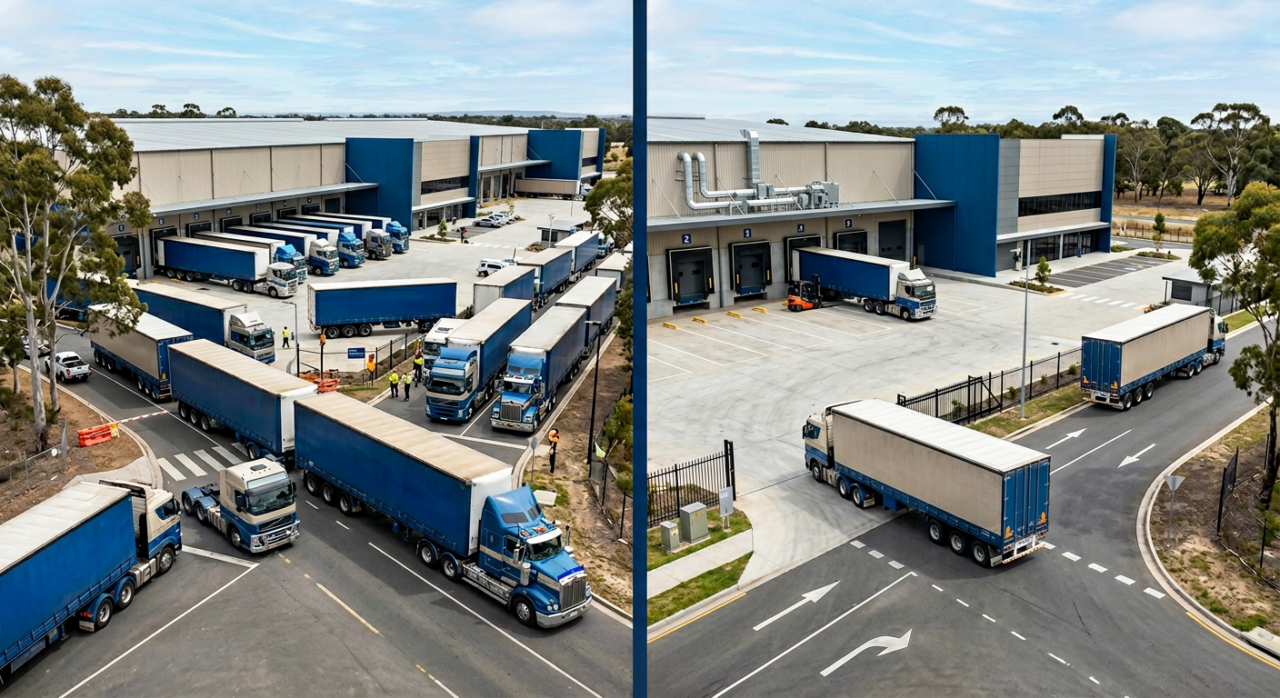
| Scheduling Style | The Goal | The Reality |
|---|---|---|
| Forward Scheduling (As Soon As Possible) | “Move it fast.” | This helps you get a lot of deliveries done. But it can cause all your trucks to arrive at once, creating traffic jams at the warehouse. It works best for clients who have flexible receiving times. |
| Backward Scheduling (Just In Time) | “Arrive exactly on time.” | This takes a bit more planning. But it’s absolutely necessary for your most important orders with strict deadlines, like those for construction sites or major retail stores. |
In our experience, the final and most expensive part of the delivery journey is the “last mile” that can make up a huge chunk of your total shipping costs. This is why getting it right is so important for protecting your profit. We often advise a simple 80/20 split:
Many businesses use route optimisation software to help manage this, which saves a lot of money on fuel and makes the whole process easier.
Our Fleet XRAY Analysis shows you how to improve efficiency.
There is a financial trap that many business owners fall into called Cross-Collateralisation. It’s important to understand what this is so you can avoid it.
In simple terms, this is when a bank links your family home to your business loan as security.
If your business has trouble paying back its loan, the bank can use the value of your home to cover the debt. This could even force you to sell your home. It legally ties your personal life to your business finances.
Our advice is to always keep your finances separate. Try to use different banks for different loans. If your business runs into trouble, the problem stays with the business and doesn’t put your family home at risk. This simple separation gives you a vital layer of protection.
“We’ve spent three decades helping businesses make these exact changes. You can keep putting out daily fires and accept it as normal, or you can use a professional system to prevent the fires from starting in the first place. The choice is yours.”
—Walter Scremin, CEO of Ontime Delivery Solutions
Here are simple answers to common questions about logistics planning.
The biggest difference is their starting point.
Neither is better all the time; it depends on your customers.
For most businesses, a hybrid approach that uses both methods works best.
This software helps by planning the best routes for your drivers automatically. Instead of someone doing it by hand, the software uses real-time information to make smart choices.
The bullwhip effect is a term for how small changes in customer orders can create bigger and bigger problems further up the supply chain. For example, a small increase in orders might cause you to panic, leading to unnecessary overtime and expensive shipping choices. A stable, hybrid scheduling model helps absorb these shocks so they don’t hurt your business.
Let’s turn your delivery department into a real advantage.
From pickup to drop-off, we make every step easier.
Need drivers? 1300 778 919