
A Deep Dive into Your Fleet’s Cost Per Kilometre
Do you know your fleet's true cost per kilometre? Our guide shows you how to calculate it, revealing…
This definitive guide directly compares the financial impact of owning an in house fleet versus outsourcing to a dedicated partner. It provides a clear framework to help you decide which delivery model will drive your Australian business growth.
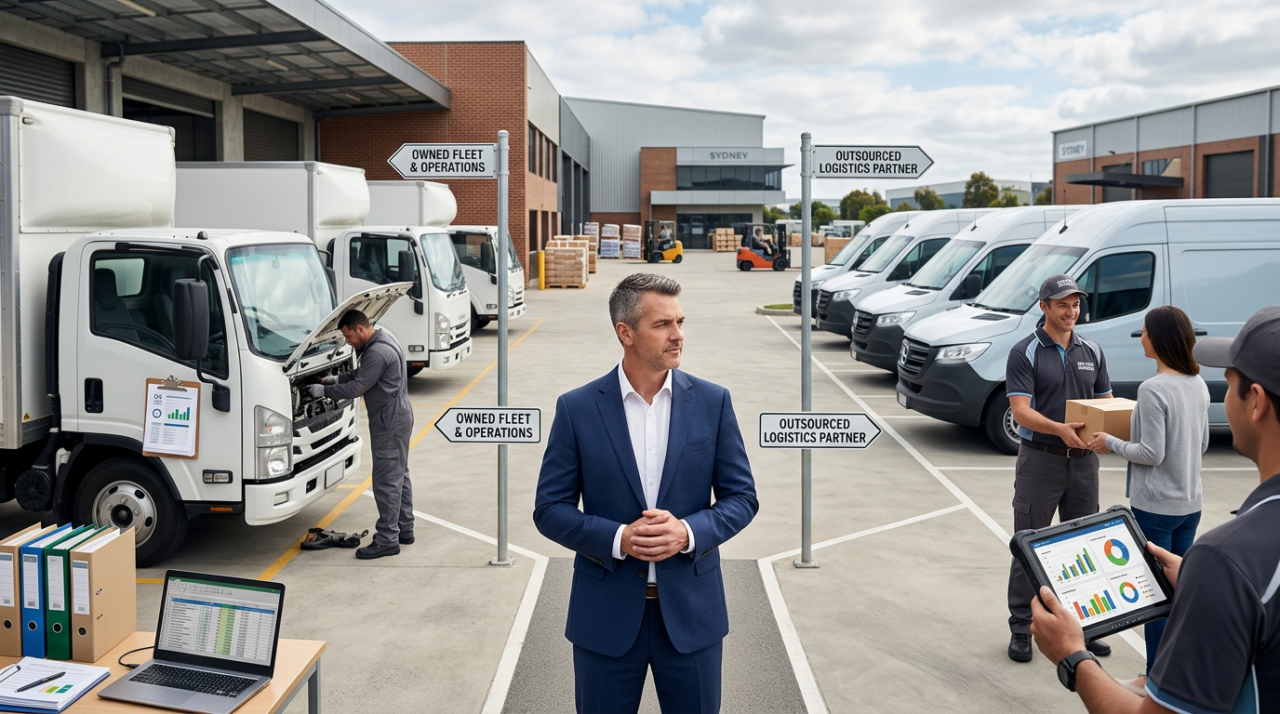
Your delivery fleet is at a crossroads. This decision can either fuel your expansion or become a constant drain on your time, capital, and focus. We are Ontime Delivery Solutions, a dedicated delivery service built for businesses that need reliable, professional logistics support. For over thirty years, we’ve worked with hundreds of Australian business owners to help them navigate the complexities of logistics through dedicated delivery services and fleet management. The question of outsourcing is a common one.
For a growing business, your choice of delivery model is a strategic decision that dictates your daily profitability and where you spend your mental energy. To help you choose with confidence, this guide provides a framework to:
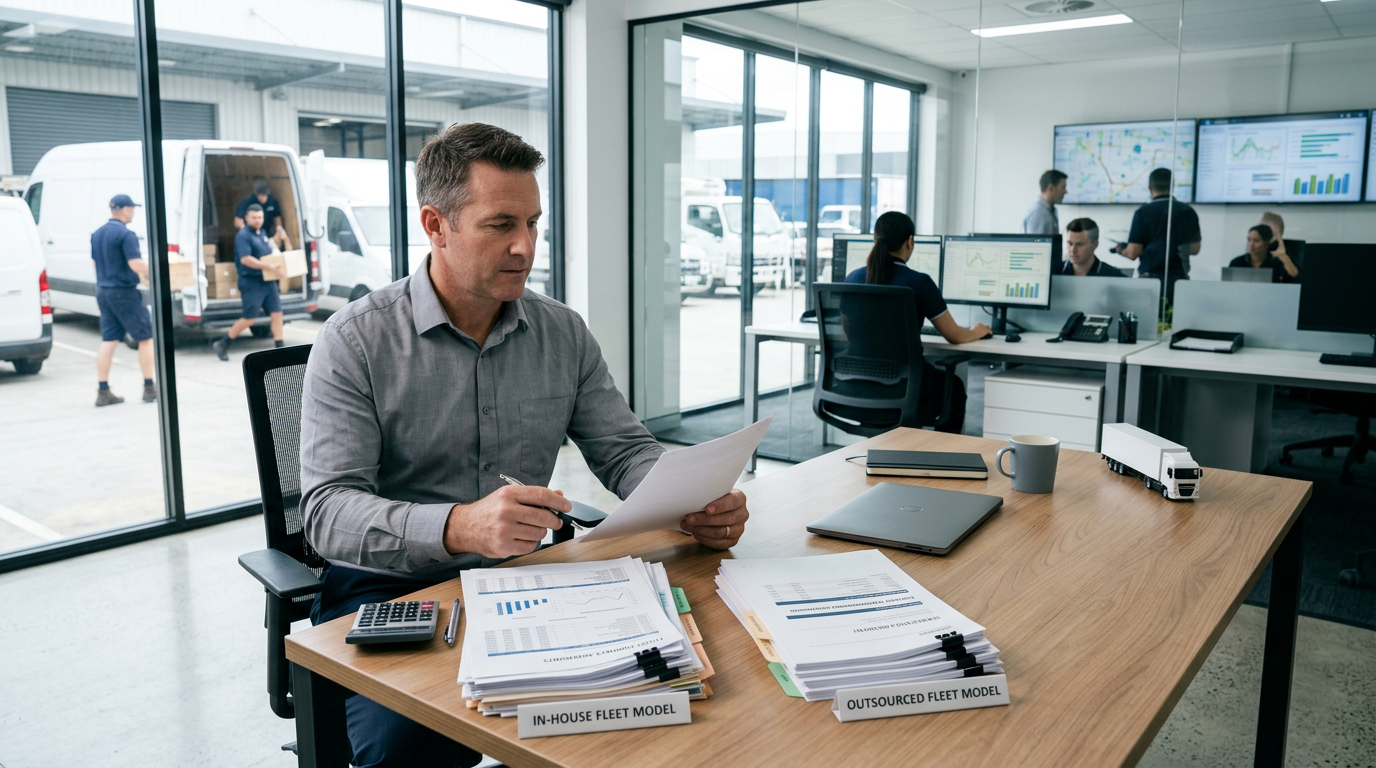
Before you can accurately compare your options, you need an honest baseline figure. Many business owners believe their logistics costs are limited to truck leases and driver salaries. However, the end of year numbers often tell a different story because they overlook the Total Cost of Ownership.
Total Cost of Ownership is the full, all inclusive cost to run your entire fleet, and it is almost always higher than expected. You cannot control all the costs associated with what you do not measure.
 A 2024 study by Deloitte suggests that hidden costs, such as unplanned maintenance and vehicle downtime, can add up to 40% to a fleet’s operating expenses. This makes the decision to buy delivery routes or consider outsourcing a critical financial consideration for your business.
“A single truck breakdown costs more than a repair bill. It can cost over 1,000 dollars per day in lost deliveries and recovery efforts. The impact on your reputation is even more significant, as 84% of shoppers are unlikely to return after one bad delivery from your fleet.”
— Ontime Delivery Solutions
To find your real total cost, perform this 15-minute calculation for one of your vehicles over the last year:
Adding these three numbers provides the true annual cost of just one of your fleet vehicles. Calculating this figure transforms vague operational frustrations into a quantifiable business case, which sets you up perfectly for the next step of comparing your capital investment.
With your total cost of ownership in mind, it is important to understand how each model impacts your ability to invest in your core business activities. This is a primary factor for any Australian SME looking to scale without being weighed down by heavy assets.
Building your own fleet requires a significant capital investment and upfront purchase. As of 2025, mid-sized trucks in Australia typically cost between 90,000 and 120,000 dollars. The rationale here is based on opportunity cost. Every dollar you spend on a depreciating truck is a dollar you cannot spend on a new sales representative or better machinery that actually grows your core revenue.
Partnering with a specialist provider converts your entire delivery operation into a predictable operational expense, much like rent or utilities. There is zero capital outlay. A partner achieves cost reductions through economies of scale that you cannot replicate alone, which leads to better route optimisation and cost savings. For instance, some reports show outsourcing can reduce fulfilment costs by 30 to 45 percent for Australian businesses and retailers.
Insight: Cash Flow Liquidity is Often More Valuable than Debt Elimination
A balloon payment isn’t just a deferred cost; it’s a strategic tool for maintaining operational liquidity. By reducing immediate monthly repayments, a business preserves the cash needed to fund daily sales activities. The cost of the final lump sum is often offset by the revenue generated by the cash saved during the loan term.
By shifting to a fixed monthly fee, you can accurately budget your logistics costs for the year. This ensures your capital is available for reinvestment in higher return areas of your business, providing a more stable foundation for your daily business operations.
The decision around outsourcing your delivery fleet is not just about money; it is about where you invest your most valuable resource: your time. Many operators find themselves managing logistics rather than focusing on their core business strengths.
The primary appeal of an in house fleet is control. However, that control means you have taken on a second job: fleet manager. The mental load of these logistics is high, and for many owners, fleet issues consume 10 to 15 hours per week. One moment you are negotiating a supplier contract; the next, you are handling a rego renewal or a broken tailgate lift. This constant switching pulls you away from the work that actually generates profit for the business.
Many business owners fear losing brand control, but a true partner acts as a seamless extension of your team. This is achieved through the dedicated driver model. We provide the same driver, in the right vehicles, every day. They are trained in your specific drop off protocols, ensuring your brand standards are maintained without you needing to manage the logistics yourself.
Insight: Logistics Management is a Resource Tax on Your Core Competency
Every hour spent on vehicle compliance or driver scheduling is a tax paid in your company’s most valuable currency: leadership focus. It impacts your business’ ability to innovate. True operational efficiency is achieved not by managing transport better, but by removing transport management from the executive desk entirely, allowing you to focus on innovation and sales.
Transitioning to a dedicated partner ensures your best people are focused on strategy rather than scheduling. This reclamation of time allows you to move from reactive problem solving to proactive business planning.
With your time reclaimed, the next factor is how quickly your business can seize new opportunities. Whether you buy delivery routes or choose to outsource, your logistics model must be able to scale alongside your sales.
An in-house fleet is a fixed asset. If you win a major contract to supply a new chain of stores, scaling from 5 to 10 trucks can require a 6 to 12 month lead time and a capital investment of over 500,000 dollars. This means your growth is often capped by your existing fleet capacity, forcing you to say no to opportunities because your logistics cannot keep up.
A partnership gives you access to an elastic fleet that grows and shrinks with your demand, matching your transportation needs exactly. With Australia’s fleet leasing sector reaching 3.6 billion dollars in 2026, businesses are clearly choosing agility. If you need five extra vans for a Christmas peak, a partner provides them and then scales them back down in January. This agility ensures your logistics accelerate your sales rather than holding them back.
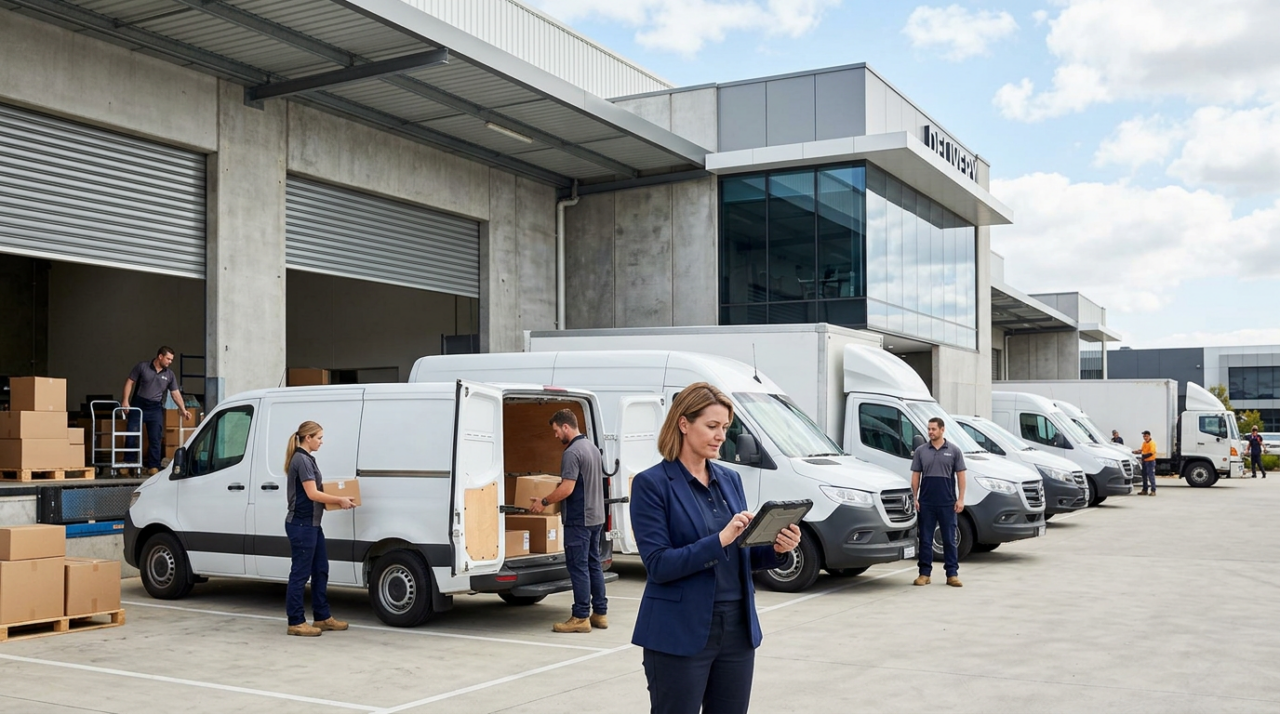
By aligning your delivery capacity with your actual demand, you ensure that no growth opportunity is missed due to vehicle shortages. This scalability provides the momentum needed to enter new markets with confidence.
Finally, with growth comes increased risk. It is important to evaluate where the burden of that risk lies and how it affects your long term stability. In Australia, the legal landscape for transport is highly regulated.
When you own the fleet, you own all the risk. This includes the legal risk of complex Chain of Responsibility laws, which means everyone in the supply chain is legally responsible for safety. A driver’s mistake can lead to large fines for your business and its executives. This is on top of the recruitment burden, with Australia facing a driver shortage of over 28,000 in 2024.
With a partnership, you strategically transfer these significant risks. Outsourcing transportation eliminates this concern, as a breakdown or a sick day becomes the partner’s problem to solve, not yours. A quality partner de-risks your operation through a Zero Downtime Guarantee. If your dedicated van has an issue, the partner immediately dispatches a backup vehicle and a fully briefed driver from their reserve fleet to complete your scheduled deliveries and maintain your operations.
Insight: The Real Cost of a Breakdown is the Loss of Customer Lifetime Value
Data indicates that 84% of shoppers will not return after a single delivery failure. A breakdown does not just cost a repair bill; it costs the total profit margin of every future order that customer would have placed. Reliability is the only hedge against permanent customer loss.
Transferring these operational risks to a specialist protects both your reputation and your balance sheet. This final step in the framework gives you the total picture needed to decide which path fits your specific growth goals.
Speak with a specialist today to identify your hidden delivery costs and reclaim your management time. Compare your logistics options now.
We have seen both models work, but they fit very different business objectives and operational needs. Be honest with yourself and see which of these sounds more like your current reality.
Read our expert breakdown of common queries regarding the transition from an in-house fleet to a dedicated delivery partner.
No, fleet outsourcing is highly effective for growing Australian SMEs and other businesses that need to bypass the massive capital expenditure of vehicle acquisition. While large corporations often have internal logistics departments, small businesses benefit from transferring the risk of driver shortages, estimated at 28,000 personnel in 2024, to a specialist partner. This provides enterprise level logistics solutions and operational agility without the fixed internal overhead.
Brand reputation is protected through a Dedicated Driver Model. Unlike a generic courier service where drivers change daily, a dedicated partner assigns a specific driver exclusively to your business. These drivers are trained in your specific protocols, such as medical drop off procedures or retail “white glove” standards, ensuring they act as permanent brand ambassadors. This model provides the consistency of an in-house employee while removing the recruitment and payroll burden.
The first step is a Total Cost of Ownership Audit. This involves a granular 15-minute calculation of your direct vehicle costs, fuel, tolls, and hidden labour expenses. Understanding your current baseline is critical because Australia’s driver shortage is projected by NatRoad to reach 78,000 by 2029. Performing an audit now allows you to evaluate if shifting to a fixed fee outsourced model offers a better long term ROI and risk mitigation strategy than managing a private fleet.
We generate revenue through long term services contracts for permanent vehicle hire and management. Our initial consultations and Fleet XRAY Analysis™ are free of charge to provide transparency and factual data about your current fleet. If the audit confirms that our dedicated delivery model reduces your delivery operations costs and improves service levels, we propose a fixed fee partnership. This replaces your variable, unpredictable logistics costs with a steady operational expense, allowing you to budget with total certainty.
See exactly how much capital you can free up by switching to a dedicated fleet. Compare your delivery options today.
The right delivery services model is more than a line item; it is a growth engine for your company. By choosing logistics solutions that free up your capital, your time, and your focus, you position your business for success and to win in a competitive market. Taking these steps ensures you are no longer just managing a fleet, but leading a successful expansion.
From pickup to drop-off, we make every step easier.
Need drivers? 1300 778 919