
Activity Based Costing for Delivery Is The Fix When Average Costs Are Killing Your Profit

Walter Scremin CEO at Ontime
logistics manager analyzing detailed cost breakdowns

A professional financial strategy session in a modern office — a small group of business executives and logistics managers reviewing financial data on a screen and laptops, discussing delivery costs, profitability, and operational efficiency.

Activity Based Costing (ABC) is a way to find out the real cost of each delivery you make.

Are you working long hours but your profits are still paper-thin? This often happens when you use an “average cost” for every job. This simple mistake hides your unprofitable clients and can cause a serious cash crisis.

This guide gives you a 4-step plan to find the true cost of serving each client. It will help you protect your profits and gain control over your business.

Key Takeaways On How to Find and Fix Unprofitable Deliveries

  • Step 1: Run a 3D Cost Analysis. Track the 5 busiest routes for one week while measuring costs at the Depot, during the Drive and at Drop-off to understand true delivery costs.
  • Step 2: Score the Bottom 20% of Clients. Use a scorecard to rank clients based on True Margin, Operational Drag and Admin Drain as part of an operational analysis.
  • Step 3: Make the Hard Call. Move any low scoring client to a new rate card that reflects their actual cost. If they refuse then you’ll let them go to protect profits.
  • Step 4: Isolate Financial Risk. Never use the same bank for home and company loans to avoid cross collateralisation which puts personal assets at risk.

On This Page

  • Step 1: Using Activity Based Costing to Find True Delivery Costs
  • Step 2: Make the Hard Call on Unprofitable Clients
  • Step 3: Understand the Hidden Impact of High Driver Turnover

Step 1: Use Activity Based Costing to Find True Delivery Costs

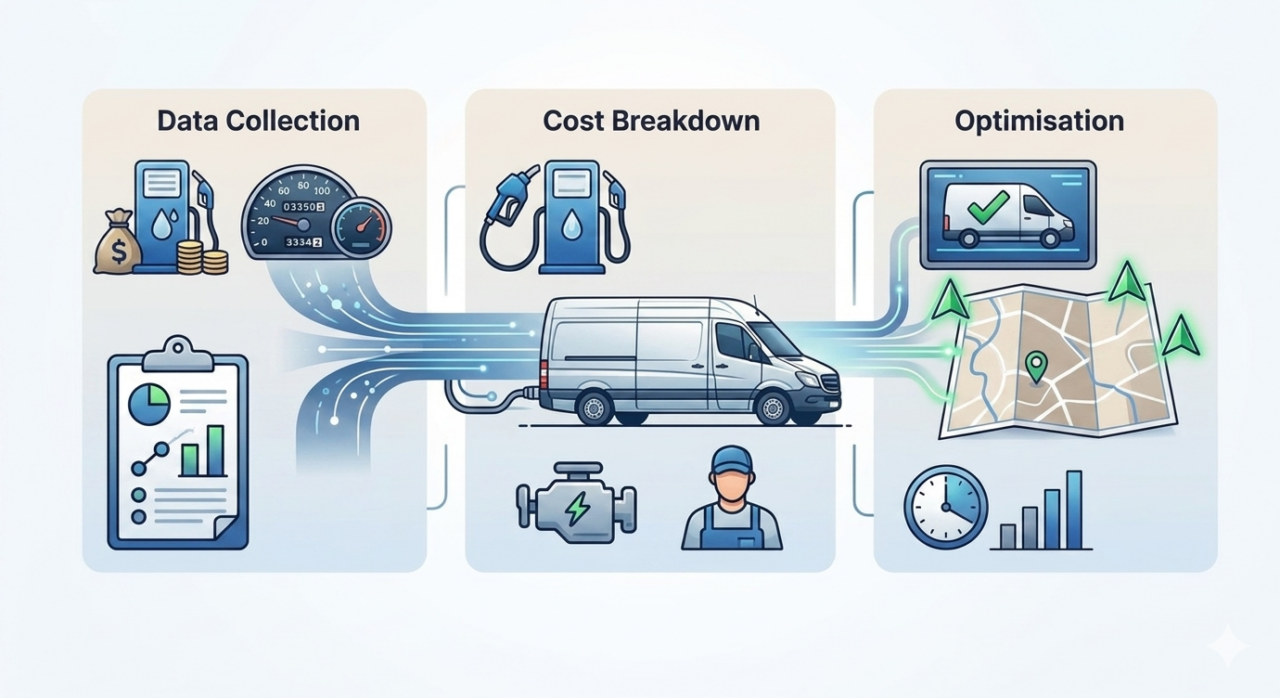
To get honest numbers, you need to look closely at your costs. A simple and powerful way to do this is with the 3D Cost Analysis: Depot, Drive, and Drop-off.

Here’s how to get started. Create a spreadsheet and track your five busiest delivery routes for one full week. Log these three types of costs to find where your profit is hiding.
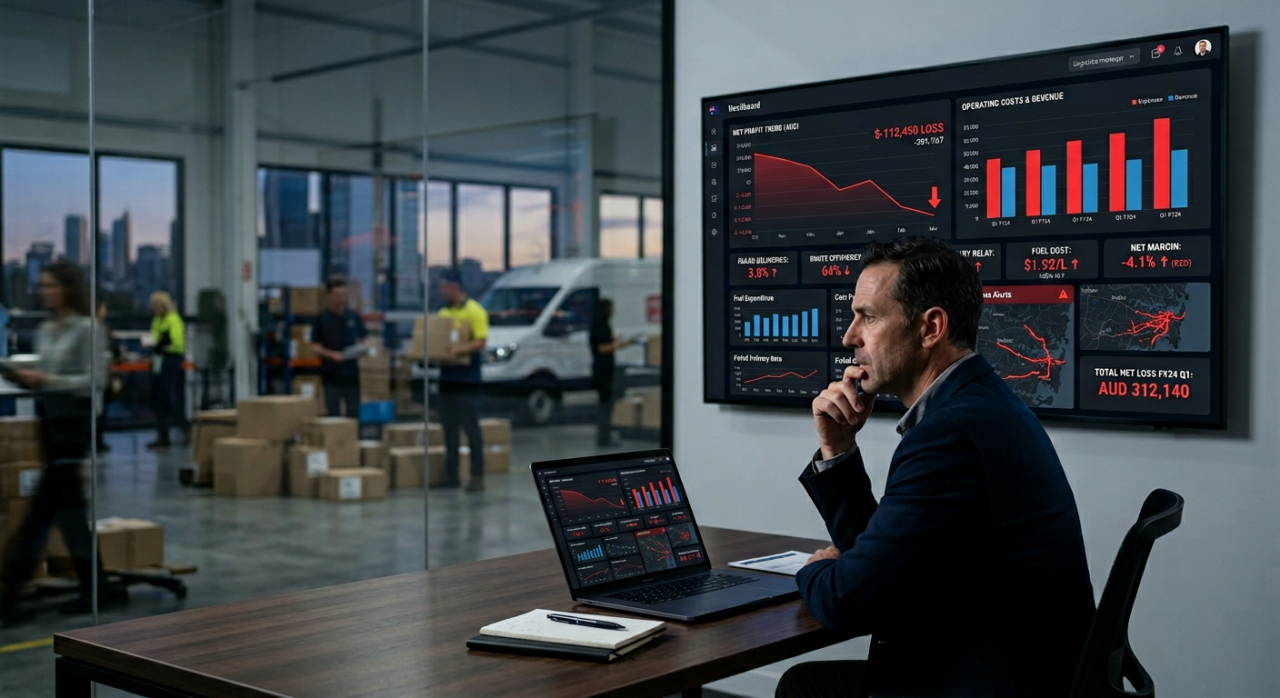
Logistics or finance manager looking stressed while reviewing a laptop with declining profit charts and rising delivery costs, dim office lighting, subtle warehouse or transport visuals in the background.

1. Depot Costs: The Load-Up
  • What to do: Use a timer to see how long it takes your staff to sort and load products for different clients. Some clients will take much more time than others.
  • Why it matters: You will quickly see that some clients are expensive before their delivery even leaves your depot.
2. Drive Costs: The Journey
  • What to do: Use Google Maps to check the real travel time for each delivery. A trip during peak-hour traffic costs you more in wages and fuel than a trip in the middle of the day. The route itself is one of the main cost drivers which makes route optimisation and cost savings a critical focus.
  • Why it matters: This simple check puts a dollar value on traffic. It proves that some routes are far more expensive to service than others.
3. Drop-off Costs: The Final Metre
  • What to do: Ask your driver to log the time from when they arrive at a client’s site to when they leave. This is called Dwell Time.
  • Insider Tip: If your driver waits 30 minutes for a client to be ready, that’s a direct loss. For example, if your operational cost is $50 per hour, a 30-minute wait costs you $25.
  • Why it matters: Dwell time is a huge profit killer in the delivery business. If a driver waits longer than 15 minutes, you are paying for your client’s inefficiency.

A clean, modern infographic-style visual showing a 3-step process for delivery cost analysis.

Once you have this data, you will no longer have to guess your costs. You will know the real-world cost for every single client. This leads to the next question: what do you do with this information?

Step 2: Make the Hard Call on Unprofitable Clients

Your data will clearly show you that some clients are costing you money.

It can be hard to let a client go. You may have invested a lot of time in the relationship. But that time and money are already gone. The only thing that matters now is what you do next.

The real problem with keeping bad clients is that they take time and energy away from your great clients. Every hour your team spends on a problem account is an hour they could have spent serving a profitable one.

The Solution: Use a Scorecard

Here is what you need to do. Score your bottom 20% of clients using these three simple metrics.

Metric Actionable Score (1-5)
True Margin 1 = You are losing money on them.
5 = They are highly profitable.
Operational Drag 1 = Their deliveries cause daily disruptions.
5 = They are seamless to work with.
Admin Drain 1 = Your admin team spends hours fixing their issues.
5 = They require zero extra admin work.

Any client with a low score needs a new price. Show them the data you collected. Explain that their new rate reflects the true cost of the service you provide. If they refuse, you need to protect your business and let them go. You are not losing a client; you are plugging a huge financial leak.

Need clarity on your profit margins?

Our Fleet XRAY Analysis™ can pinpoint exactly where your profit is leaking.

Learn More About Profit Analysis 

Step 3: Understand the Hidden Impact of High Driver Turnover

You need to understand how much it costs when a good driver leaves.

Driver turnover is a huge financial drain on a business. In Australia, there is a projected shortage of over 28,000 drivers in 2025, according to TransVirtual. Research from Queensland’s TMR in 2022 showed turnover impacted nearly 40% of the transport workforce. [Source Links Here]

The Real Cost to Replace a Driver

In my experience, the true cost to replace one good, experienced driver is between $8,000 and $12,000. This number comes from three specific costs:

  • Recruitment: The cost of job ads and the management time spent on interviews.
  • Training: The time and resources spent to get the new hire ready.
  • Productivity Loss: A new driver will naturally make more errors and work slower in their first few months.

My advice is to treat your drivers like valuable assets. Keeping a stable, professional team is a profit-generating strategy because it saves you that $10,000 hit every year.

Your Action Plan to Take Back Control

It’s time to move from guesswork to a real plan of attack. Here is what you can do this week to start taking control of your profitability.

  1. Execute the 3D Audit: Measure your Depot, Drive, and Drop-off costs on your five busiest routes.
  2. Isolate the Sinks: Score your bottom 20% of clients using the Profitability Scorecard.
  3. Make the Hard Call: Renegotiate rates with difficult clients or decide to let them go.
  4. Isolate Your Risk: Check that your home and business loans are with different banks.

“For over 20 years, I have seen these exact steps turn delivery businesses from cost centres into profitable, competitive companies. The fastest way to do this is to have an expert help you. If you would like my team to run the numbers with you, I recommend booking our Fleet XRAY Analysis.”

—Walter Scremin, CEO of Ontime Delivery Solutions

Frequently Asked Questions About Delivery Costing

Customer support agent assisting a business client via video call, both smiling and engaged, with delivery-related visuals on screen, modern and professional setting.

How does Activity Based Costing differ from traditional methods?

Traditional costing uses one average price for all jobs. It is simple but very inaccurate. In contrast, activity based costing is a detailed method that finds the unique cost of each job. It shows you the true profit on every client.

What are the main cost drivers in last-mile delivery?

The main costs in the final stage of delivery usually fall into three groups:

  • Labour and Inefficiencies: This includes driver wages and any time spent not driving. The biggest hidden cost here is Dwell Time (when a driver has to wait at a location).
  • Fleet Operating Costs: This covers fuel, vehicle maintenance, insurance, and wear and tear.
  • Failed Deliveries: Every time a delivery fails on the first try, you have to pay for the wages, fuel, and admin time for a second trip.

Can I calculate true delivery costs without special software?

Yes. You can do a manual check using a simple spreadsheet. Ask your drivers to log their time spent sorting, driving, and waiting at each drop-off. You can then multiply the time spent on each task by your hourly operational cost to find the true cost.

Why is it risky to have only one transport provider?

Using only one provider creates a single point of failure. It might seem convenient, but if that provider has a problem, like a depot closure or a computer issue, your entire supply chain can stop. A more resilient choice is to use different specialists for different needs.

It’s time to fix your profit leaks for good.

Let an expert help you apply this framework to identify unprofitable clients.

Book Your Free Analysis Now

Related articles

Professional logistics strategy meeting (2)
Blogs -

Backward vs Forward Scheduling And How Choosing the Right Model Will Get You 98% Reliability

Guarantee zero downtime for your operations ✓ with a reserve fleet ✓ at Ontime Delivery Solutions.…

logistics manager analyzing detailed cost breakdowns
Blogs -

Activity Based Costing for Delivery Is The Fix When Average Costs Are Killing Your Profit

Uncover the true cost of your deliveries ✓ with our expert analysis ✓ at Ontime Delivery Solutions.…

image
Blogs -

Why ‘Tendered for Delivery’ Is a Red Flag for Your Stuck Shipments

Get complete transparency with real-time delivery tracking ✓ at Ontime Delivery Solutions. If you're…

Contact Us

Please complete all mandatory fields

Please select an option
Please enter your first name
Please enter your last name
Please enter a valid phone number
Please enter a correct email address
Please select a state
Please tell us your industry.
Please enter message
Please agree to the terms