


What Fleet Idling is Costing Your Business Every Year And How to Stop It
See what fleet idling is costing your business ✓ with our free Fleet XRAY analysis ✓. We identify the…

Fleet idling, the practice of leaving a vehicle’s engine running while stationary, might seem harmless. However, it quietly drains your business’s profits through wasted fuel, hidden maintenance costs, and accelerated vehicle depreciation. Suddenly, those ‘harmless’ minutes of engine idle look like a serious own goal against your bottom line. This guide provides a simple way to calculate the exact financial impact of idling and presents an actionable plan to stop it, a key part of our overall approach to route optimisation and cost savings.
To understand the real financial impact, you’ll need to calculate the figure for one vehicle, then multiply it across the entire fleet. Quantifying your fleet’s idling liability is the first step to effective fleet management and achieving significant financial benefits.
(Daily Idle Hours) x (Litres Used per Hour) x (Cost per Litre) x (Operating Days per Year) = Total Annual Expense of Wasted Fuel

Here’s an example for one truck:
(1.5 hours) x (2 litres/hour) x ($2.45/litre) x (250 days) = $1,837.50 per year
This calculation turns a vague problem into a specific dollar figure. For a small operation of just five trucks, this preventable expense can easily exceed $9,000 annually. That’s thousands of dollars per vehicle just vanishing into thin air.
The direct fuel expenditure is just the beginning. The true financial damage of what fleet idling is costing your company hits your budget, your maintenance schedule, and your long-term asset value. The idling motor is a silent assassin of your profit margin.
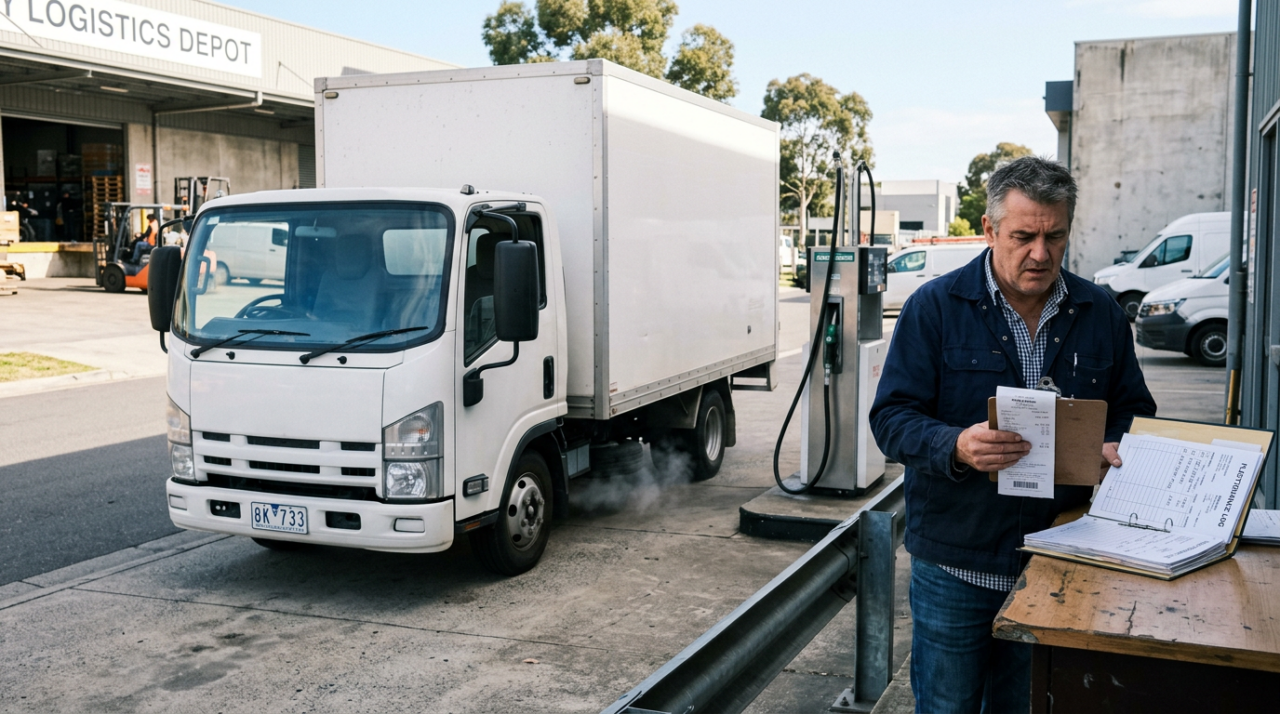
The problem: An idling motor is harder on itself than a running one. It creates what we call “ghost miles,” a type of mechanical strain that your odometer doesn’t track.
Why it matters: This premature wear often shows up as expensive failures in components like fan belts and injectors, leading to more frequent and costly maintenance bills for the entire fleet.
The problem: Hidden wear from ghost miles makes your regular kilometre-based maintenance schedule inaccurate. The motor has worked much harder than the kilometres suggest.
Why it matters: This leads to unexpected and expensive on-road breakdowns that could have been predicted and prevented if you were tracking the vehicle’s true workload, including all idle periods.
The problem: When it’s time to sell your vehicles, savvy buyers look at total engine hours, not just kilometres. A truck with a high amount of idle time is a red flag.
Why it matters: A truck with excessive idle time is a clear sign of a hard life. It’ll be worth significantly less than a vehicle with the same kilometres but fewer hours on the motor, which will impact the return on your initial investment.
Idling isn’t just wasting fuel; it’s eroding your profit margin one minute at a time. Our free Fleet XRAY Analysis identifies exactly where your money is going up in smoke.
Book Your Free Fleet XRAY Analysis
Now that you can see the full operational impact, it’s time to stop burning cash and start kicking goals. Here are the two pillars of an effective anti-idling strategy for any fleet that will slash your fuel consumption.
You can’t fix what you don’t measure. The most effective way to obtain precise information is to use GPS tracking to monitor idling. This technology provides detailed reports on each vehicle’s idle time, offering the clarity needed for smart fleet management.
Imagine you suspect two of your drivers are idling too much. Here’s how GPS telematics makes the problem solvable.
You tell both drivers to “idle less.” Driver A tries his best, but Driver B ignores the advice. You have no way to verify who is following the policy, and your fleet’s overall fuel bill barely changes. The operational expenses remain high.
A telematics report from your GPS system shows that Driver A idles for 15 minutes a day, while Driver B idles for 90 minutes, mostly at the same delivery site. The information pinpoints the problem.
The Verdict: Proper tracking turns a vague, unmanageable problem into specific, solvable issues. It’s the cornerstone of effective fuel management and reducing operational expenditure.
Once you have accurate GPS tracking insights, you can take meaningful action by combining clear policies with effective driver education. This is how you embed real change in your drivers’ behaviour.


A heavy-duty truck typically burns between 2 and 4 litres of diesel per hour while idling. This figure is a reliable benchmark for calculating wasted expenditure. The exact amount of fuel consumption can vary based on several factors, including:
For any business looking to calculate these figures, a conservative estimate of 2 litres per hour provides a strong baseline for understanding the financial impact on the fleet.
It’s almost always better to restart a truck’s powertrain than to let it idle for an extended period. The common belief that restarting uses more energy is a myth for any stop longer than a few seconds, and tackling this misconception with your drivers is key to improving efficiency.
The trade-off between idling and restarting can be summarised by the “10-Second Rule,” a guideline supported by various studies:
For fleet managers creating anti-idling policies, instructing drivers to turn off vehicles at any stop lasting more than 1 minute is a safe, highly effective rule that delivers immediate results.
Idling causes more accelerated component damage than normal driving because it forces the powertrain to operate in suboptimal conditions. This leads to internal issues that are not reflected in your vehicles’ odometers, impacting your maintenance budget.
The primary mechanisms for this increased strain are:
This is why total operating hours, including all idle periods, are a more accurate measure of a vehicle’s true operational life and a critical piece of information for fleet maintenance.
Need help finding the profit leaks in your delivery operation? A deep dive into your operational patterns can reveal thousands in potential efficiencies from issues like excessive idling. Our free Fleet XRAY Analysis can give you the clarity you need.
Contact our team on 1300 778 919 to book your complimentary Fleet XRAY Analysis today.
From pickup to drop-off, we make every step easier.
Need drivers? 1300 778 919