
Solving the Driver Retention Problem Without the HR Headache

image

A dedicated delivery driver and logistics manager standing beside a clean delivery van at a warehouse dispatch area.

High driver turnover is the constant, expensive cycle of hiring and training drivers only to see them leave. This “revolving door” quietly drains your time and money, forcing you to act as a full-time HR manager. This guide explains the real reasons good drivers quit and outlines how an outsourced driver hire model can give you a stable, professional workforce.

Key Takeaways for Better Driver Retention

  • Diagnose the real issues: It’s not just about pay. Common reasons why delivery drivers quit include a lack of schedule stability, feeling disconnected, and burnout from inefficiency.
  • Understand the true cost: It’s more than a job ad. The cost extends far beyond a job advertisement. Replacing a single operator can exceed $8,000 in direct and indirect expenses, impacting your bottom line.
  • Implement the solution: Outsource the HR burden. A dedicated outsourced model addresses the root causes of turnover by providing stability and professional management.
  • Get the payoff: A stable workforce and zero downtime. If a dedicated operator is sick, a trained backup is automatically deployed, guaranteeing operational continuity for your business.

The Real Reasons Good Delivery Personnel Quit

Our analysis of logistics operations shows that addressing staff instability is rarely a matter of compensation. The real challenges are almost always operational and cultural. Here are the top three systemic failures that lead to high driver turnover:

1. Unstable and Unpredictable Schedules

A delivery driver in a break area, looking frustrated while checking a phone showing a last-minute schedule change.

The problem: Good, experienced professional drivers value being able to plan their lives. If rosters are sent out with less than a week’s notice or drivers are frequently asked to change shifts, it creates stress and shows a lack of respect for their time.

Why it matters: This uncertainty forces the best people to look for a more stable contract, leaving a revolving door of less reliable staff and a constant retention problem.

2. Poor Work Environment: Feeling Undervalued and Disconnected

A delivery driver standing alone near a parked van, checking a phone with a disappointed or disconnected expression.

The problem: Driving can be a solitary job. If drivers receive instructions only via text and receive little to no positive feedback, they can feel isolated. A positive work environment is key.

Why it matters: Without a system for communication, they have no reason to stay loyal when a better offer appears. Effective driver management involves open communication and mutual respect.

3. Systems That Cause Burnout

A stressed delivery driver in a yellow-green safety jacket sitting in a van looking at a confusing route on a phone.

The problem: Nothing burns out a good driver faster than being set up to fail. Sending them out with inefficient routes is a daily source of stress and frustration. This is a fundamental operational failure.

Why it matters: This operational flaw creates a reputation as a tough place to work, making it even harder to attract good talent in the future.

The Financial Cost of High Turnover

While the cost of a job ad is visible, reducing turnover costs requires looking at the unseen expenses. This “revolving door” of good drivers is a silent profit killer. A study from the Upper Great Plains Transportation Institute found the real cost to replace a single driver can top $8,000, and this is even higher for specialised roles.

  • Recruitment Costs: The non-billable hours staff spend on admin tasks like writing ads, screening resumes, and conducting interviews.
  • Training & Onboarding Costs: A comprehensive driver onboarding process is essential for long-term driver retention, but there is a period where a new hire is a net loss, including wages while they learn the route and the time a senior staff member must spend supervising them.
  • Lost Customer Relationships: The damage to trust when a familiar, reliable driver is replaced by someone new, who is naturally more prone to errors.

Stop Guessing. Start Solving.

See the real cost of your driver turnover and get a clear, data-driven plan to fix it.

Book Your Free Fleet XRAY Analysis Today

Effective Retention Strategies: Outsourced Fleet Management

The smart alternative to becoming an HR expert is to adopt a model that delivers a stable, professional operator without the internal headaches. A dedicated outsourced partner solves retention challenges by building a system that gives professionals exactly what they’re looking for. This is a core principle of effective fleet management.

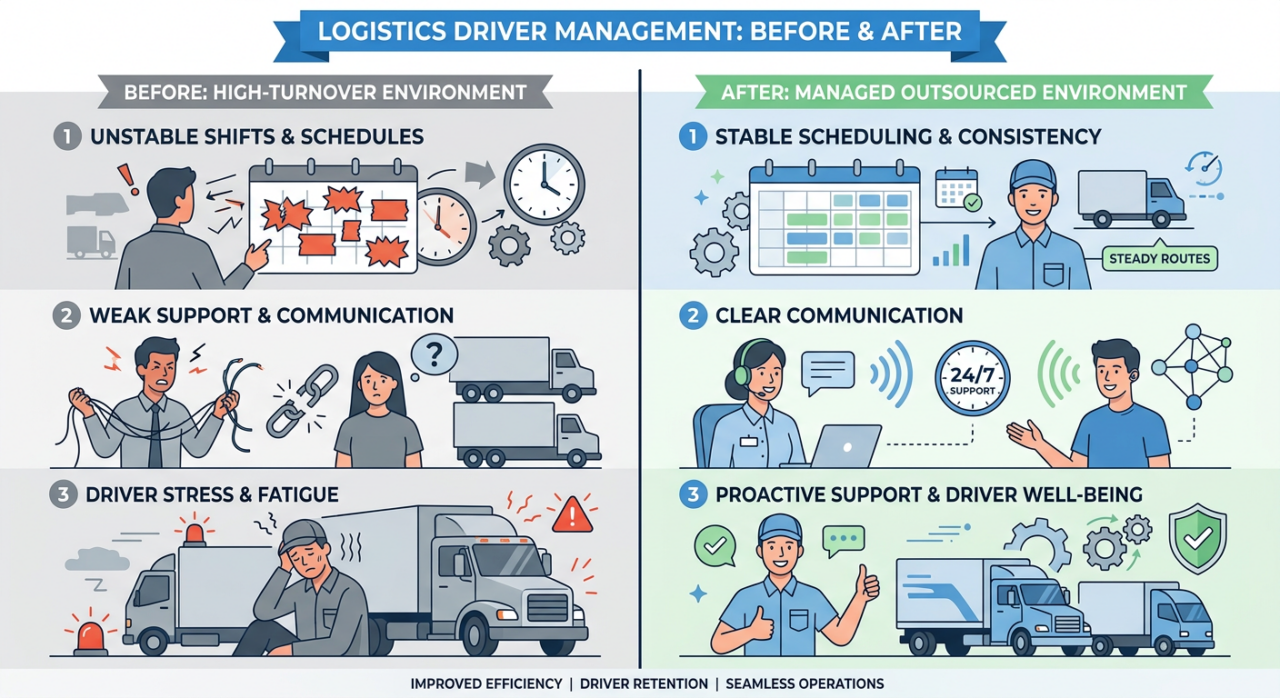
A side by side comparison graphic of a logistics driver management.

Putting It Into Practice: A Tale of Two Scenarios

Let’s compare the experience of a professional in two different environments to see the benefits of an outsourced model.

The In-House Hire (High-Turnover Environment)

An operator is hired directly by a company whose core business isn’t logistics. Their experience often looks like this:

  • Day 1: Receives a last-minute schedule via text. The assigned journey is inefficient, causing a stressful day.
  • Week 2: The only manager who knows the delivery plan is on holiday, creating an information vacuum.
  • Month 2: After weeks of unpredictable shifts, the operator accepts another job. The hiring cycle starts over.

The Outsourced Professional (Professionally Managed Environment)

The same professional works for a specialist logistics partner, but is dedicated to a client’s company full-time. They’re offered the kind of stability and support found in the best owner driver jobs. This is achieved through a proven methodology:

Step 1: Professional Onboarding

A new delivery driver in a yellow-green safety vest being welcomed and briefed by a logistics manager in a clean office.

Step 2: Optimised Systems

A clean, well-organised dispatch bay early in the day, showing a delivery driver in a yellow-green preparing to leave in a clean white delivery van.

Step 3: Proactive Support

A supportive manager in a clean office having a positive check-in conversation with a delivery driver wearing a yellow-green safety jacket.

With this structured approach:

  • Day 1: The operator is part of a professional team. Their route is optimised, their schedule is stable, and they have clear goals.
  • Week 2: They have regular check-ins with their manager and feel supported, improving morale and stability.
  • Month 2: The operator feels valued. If they call in sick, a backup is deployed, so the client’s operation experiences zero disruption.

The Verdict: An outsourced model solves the root causes of turnover like instability and lack of support, creating a stable, professionally managed workforce. This eliminates the HR burden and allows you to focus on your core business.

Frequently Asked Questions

How is an outsourced solution different from a recruitment agency?

The primary difference is the scope of service and accountability. A recruitment agency provides a transactional service to fill a vacancy, while a managed service solution provides a continuous operational service and a built-in retention program that guarantees performance.

Here is a direct comparison of the trade-offs:

Recruitment Agency
  • Function: Finds and places a candidate for you to employ directly. Their job ends after the placement.
  • Risk: You’re responsible for all ongoing HR, payroll, performance management, and finding a replacement if the hire leaves.
Managed Service Solution
  • Function: Provides a fully managed operator who is their employee. They handle all HR, payroll, and compliance.
  • Risk: The provider is responsible for performance and continuity. If the dedicated operator is sick, they deploy a trained backup, ensuring zero downtime for the client’s company.

Who is the legal employer of the driver?

In a dedicated outsourced model, the operators are legally considered employees of the managed service provider, not the client’s company. This is a key benefit as it transfers the significant legal and financial responsibilities of employment.

The provider manages all aspects of contractor administration, including:

  • Payroll and PAYG compliance
  • Superannuation contributions
  • Workers’ compensation insurance and claims
  • Compliance with industry awards (e.g., Road Transport and Distribution Award)

This structure allows a business to benefit operationally from a dedicated operator without the direct legal and administrative burden of being the employer.

What if a dedicated driver isn’t a good fit?

If a dedicated operator isn’t a good cultural or operational fit, a professional managed service provider will handle the entire resolution process. Unlike direct employment, where you must manage performance issues or termination, an outsourced model simplifies this.

The process typically involves these steps:

  1. You provide feedback to the service provider about the specific challenges you face.
  2. The provider manages performance: They conduct the necessary HR conversations, coaching, or performance management. They may also seek your suggestions.
  3. A replacement is arranged: If the problems can’t be resolved, the provider will source and train a new dedicated operator, saving the client time and stress from the HR process.

Is an outsourced model right for small businesses?

Yes, an outsourced driver model is often ideal for small businesses because it solves the “single point of failure” issue. This happens when an operation relies on just one or two key drivers.

The model provides two main advantages for smaller operations:

  • Removes Fragility: If your only driver calls in sick, your entire delivery operation comes to a halt. A managed solution provides a backup driver, ensuring operational continuity.
  • Provides Professional Scale: It gives you access to a large, professional, and managed workforce, complete with support and rewards systems, without the high overhead costs of building one internally.

Your Next Step Is To End the Revolving Door

Need help finding a more stable solution? Our free Fleet XRAY Analysis can give you the clarity you need to move forward.

Call us at 1300 778 919 to book your complimentary Fleet XRAY Analysis today.

Related articles

image
Blogs -

Solving the Driver Retention Problem Without the HR Headache

Get a dedicated driver team ✓ solving the driver retention problem for you ✓. We absorb the complexities of…

image
Blogs -

Proof of Shipment vs Proof of Delivery And Our Guide to Winning Every Dispute

Get reliable, real-time proof of delivery ✓ and understand the key differences ✓. We explain proof of…

image
Blogs -

Engine Hours vs Kilometres And The Hidden Costs of Managing Your In-House Fleet

Uncover the hidden costs ✓ of your in-house fleet by looking at engine hours vs kilometres ✓. This guide…

Contact Us

Please complete all mandatory fields

Please select an option
Please enter your first name
Please enter your last name
Please enter a valid phone number
Please enter a correct email address
Please select a state
Please tell us your industry.
Please enter message
Please agree to the terms